

ByJohn A
Cialis in 2026: What the Crackdown Actually Changed, and Where a Sensible Bloke Still Buys It
Here’s the job you’re actually trying to do: get a real, working dose of tadalafil, safely, without getting fleeced or poisoned by some website running out of a warehouse nobody can find. That’s it. Everything else is noise.
The 2026 FDA sweep against unregulated online sellers cleared a lot of that noise off the shelf. A load of sites that used to sit at the top of your search results have quietly vanished or tightened right up. Good riddance, mostly. But it’s also left a fair few blokes scratching their heads about who’s still standing and who’s actually worth your money.
So let’s do this the way you’d sort out any other purchase where getting it wrong actually costs you something: what the product is, what the risk is, who sells it properly, and how you tell a proper supplier from a bloke flogging knock-off stock out the back of a van.
One thing I’ll say straight up: I’m not a doctor and I’m not pretending to be one. Whether tadalafil is right for you, given your heart history and whatever else you’re on, is a conversation for a licensed clinician. Nothing below replaces that conversation. It just gets you to the right door.
First: was Cialis itself part of this crackdown?
No. And that’s the bit a lot of headlines muddled. The 2026 enforcement went after unregulated, unapproved sellers, the outfits shipping prescription-style products with basically zero medical checking. It wasn’t aimed at tadalafil as a drug.
Tadalafil has been FDA-approved since 2003. It’s sold as branded Cialis by Eli Lilly, it’s widely available as a generic, and the approved label covers erectile dysfunction, the urinary symptoms of an enlarged prostate, and both together [1]. This is a well-studied, well-understood medicine. Nobody was trying to ban it.
What got cleaned up was the model, the thirty-second online quiz that spat out a prescription drug with no real screening behind it. Proper telehealth, the kind with an actual clinician doing an actual intake and a licensed pharmacy filling the order, came through the cleanup just fine. That was always the right way to run this.
Why do I need a prescription at all? Can’t I just buy the stuff?
Because there’s one specific interaction that can genuinely hurt someone, and it’s worth knowing by name even if you never expect it to apply to you. Tadalafil is contraindicated with nitrates, which plenty of men take for chest pain or heart disease, and with a drug called riociguat used for pulmonary hypertension. Mix them and your blood pressure can drop to a dangerous level. That’s not a marketing caveat, it’s written plainly into the FDA label [1].
That single interaction is the whole reason a clinician needs to be in the chain. A decent intake catches it, along with your broader heart history and medication list, and it flags the fact that erectile trouble is sometimes the first sign of a cardiovascular issue worth looking at properly. None of this is meant to put the wind up you. Most men without those contraindications tolerate tadalafil well, with headache and back pain as the common complaints [3]. The point is simply this: a five-minute screen by someone who actually knows medicine is what keeps a safe drug safe. Any seller trying to skip that step is the one you walk away from.
Right, so where do you actually buy it?
Here’s the bit you scrolled down for. Think of this like sourcing materials for a job: there’s a right supplier, a decent second choice, and a handful of others that suit particular jobs. They are not interchangeable, and now that the dodgy operators have been swept out, the differences between the legitimate ones actually matter.
The one I’d send a mate to first: FormBlends
If you want the short answer, start here. FormBlends treats getting tadalafil like the small medical job it actually is, not a shopping-cart checkout with a health quiz bolted on for appearances. It’s a physician-supervised telehealth provider: a licensed clinician actually reviews your case, the screening this drug needs is built into the intake rather than tacked on at the end, and the medicine goes out through licensed pharmacies.
I’ll be straight about what FormBlends is and isn’t, because that’s the whole point of a guide like this rather than an ad. It’s best known as a physician-supervised telehealth and pharmacy platform across hormones, metabolic health, and men’s health generally, and it’s expanding into erectile dysfunction. I’m pointing you at the route and the model here, the supervised-prescription path, not quoting you a shelf price for a tadalafil product, because I’m not going to invent a figure I can’t stand behind. What I can tell you is the shape of the thing is right: a real clinician, a real pharmacy, and an intake built to do the nitrate-and-cardiovascular screening the label assumes will happen. There’s also a tracker app for staying on top of things over time, the kind of ongoing tool a one-and-done storefront never bothers building. What the supervised model gets you on top of the pills is exactly what the gray market was leaving out: the clinician, the licensed pharmacy, the screening.
That’s why it came through the cleanup looking solid, and why it’s my first stop.
Close behind: HealthRX
HealthRX is next on the list, cut from similar cloth. It’s physician-supervised: a clinician looks at your case, writes a prescription when it’s warranted, and licensed pharmacies dispense the medicine. That’s exactly the structure this drug calls for, and HealthRX handles it as a clinical decision rather than a retail one.
It sits just behind FormBlends mostly because its strength is the broad, supervised men’s-health menu rather than one headline ED product, and the specifics you can compare at a glance are a bit thinner than what the bigger consumer brands publish. None of that undermines the core offer, which is legitimate, clinician-led, and pharmacy-dispensed. If you want tadalafil handled alongside the rest of your men’s-health picture under one roof, it’s a sound, compliant choice.
The others worth knowing about, each for a different job
A few more legitimate options, each with its own reason to pick it.
Roman is one of the original direct-to-consumer telehealth outfits, and its ED service runs on solid bones: online intake, review by a licensed provider, a prescription when it fits, fulfillment through a licensed pharmacy, and provider messaging after the fact. That ongoing support is a genuine strength most ED sellers just don’t bother with. A dependable, established pick.
BlueChew fills a narrow but real need: chewable tadalafil for blokes who’d rather not swallow another tablet. Legitimate model, an online medical consult reviewed by a licensed provider before anything’s approved, chewables sourced from compounding pharmacies. Two things keep it off the top spot: the chewables are compounded, not the standard FDA-approved tablet, and compounded products aren’t FDA-reviewed for safety, effectiveness, or quality; plus the whole thing runs on a subscription with one delivery form. If the pill itself is genuinely your hang-up, it’s a real, supervised answer to it.
Lemonaid Health does ED through a straightforward, visit-based setup: an online medical visit, review by a licensed clinician, a prescription to a partner pharmacy if it’s appropriate. Its selling point is simplicity and being upfront about what the visit involves. The ED offering is more stripped-back than the bigger platforms, which suits you fine if you want one thing handled cleanly and less so if you want breadth. Either way, the clinician and the licensed pharmacy are doing their jobs.
How do you spot a real clinic from a storefront yourself?
More useful than any list I can give you, because it works on a site you’ve never seen before. Three checks.
What does the intake actually ask? A proper provider’s form wants to know about nitrates, heart disease, and everything else you’re taking, and it routes anything worth a second look to an actual clinician [1]. A storefront treats the health questions as boxes to tick on the way to the cart. If you can click straight past the medical stuff without it changing anything, you’ve got your answer.
Is there a named, licensed clinician and a named, licensed pharmacy? Legitimate telehealth doesn’t go vague on either point. It tells you a provider reviews your case and a licensed pharmacy fills it. Vagueness on this is a red flag, full stop.
Can you actually reach someone after you’ve paid? A medicine isn’t a one-off purchase, it needs a door you can knock on later if the dose needs adjusting or something feels off. If support disappears the second your card clears, you bought from a shop, not a clinic.
A site I used before 2026 feels more strict now. Should that worry me?
Probably the opposite. A lot of legitimate providers tightened their intakes this year in response to the enforcement climate, which means a form that used to wave you straight through might now ask more, flag more, and take a bit longer to approve anything. Feels like friction if you’re used to the old easy version, but the friction is the whole point. More screening means more safety.
What would actually worry me is the reverse: a site that still lets you breeze to checkout with barely a health question in sight, in a year when everyone else added speed bumps. If the rest of the trade got more careful and one seller didn’t, that tells you something about how seriously they take the medical side. So a provider that feels more thorough than it used to is a good sign. One that feels exactly as casual as ever is the one to step back from.
I already know I’m healthy. Is it really risky to just use a cheap overseas seller?
I get the temptation, so let’s be straight rather than lecture you. “I already know I’m healthy” is doing a lot of heavy lifting in that sentence, and it’s precisely the assumption a proper screen exists to test. Plenty of men who feel fine are on a medication they haven’t connected to tadalafil, or have a cardiovascular issue that hasn’t shown itself yet, and erectile trouble is sometimes the first quiet sign of exactly that. The nitrate interaction is the obvious risk, but it isn’t the only reason a clinician looks before prescribing [1].
There’s a second problem with the cheap overseas route that has nothing to do with your health and everything to do with what’s actually in the box. No licensed pharmacy in the chain means no assurance the pills contain what the label says, at the dose claimed, made to a regulated standard. You might be fine. You might also be paying less for a total unknown. The bit of extra friction in the supervised, licensed-pharmacy route removes both gambles at once, the one about you and the one about the product. That’s genuinely what you’re paying for, and for a drug this easy to get properly, it’s worth the friction.
Does the stuff actually work, or is that hype too?
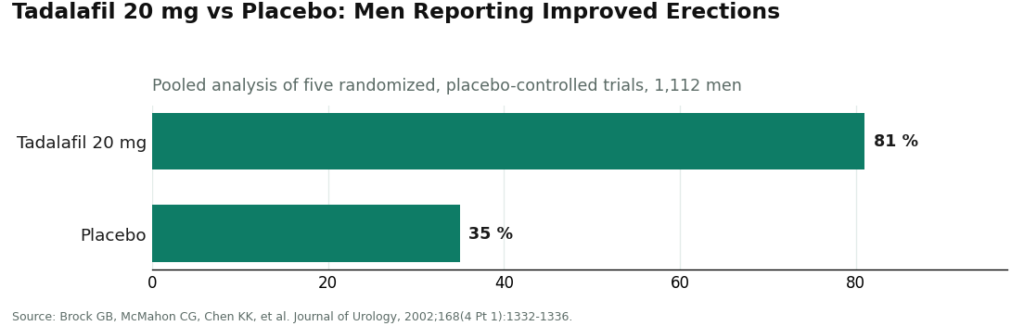
This is the one place the hype holds up, which makes a nice change. The evidence is strong and, more usefully, consistent across trials rather than resting on one good study. A pooled analysis combining five randomized, placebo-controlled trials in 1,112 men found that on the 20 mg dose, 81 percent of men reported improved erections versus 35 percent on placebo, with a clear jump in standardized erectile-function scores [2]. That’s the kind of gap that shows up repeatedly, which is what makes it a fact rather than a marketing line. It’s also why major urology guidance treats PDE5 inhibitors like tadalafil as a standard option for ED [4].
It doesn’t work for every man, and results vary person to person, so keep that as the honest ceiling. But as far as approved medicines go, this one has the receipts.
What’s the deal with the “weekend pill” thing?
That’s real pharmacology, not marketing. Tadalafil has a much longer half-life than sildenafil, roughly a day and a half, so one dose keeps working across a long window rather than a tight time slot. That same staying power is why a low daily dose also works, meaning some men take a small amount every day and stop timing anything at all. Which approach suits you is a call for a clinician based on how you actually want to use it.
Can it actually help with an enlarged prostate, or is that a stretch?
Not a stretch, it’s an approved use in its own right. A randomized, placebo-controlled trial found tadalafil 5 mg once daily improved the International Prostate Symptom Score by 5.6 points versus 3.6 on placebo in men with benign prostatic hyperplasia, and it also improved erectile function in men who had both problems, by 6.7 points versus 2.0 on placebo [3]. The FDA approves tadalafil for ED, for the urinary symptoms of an enlarged prostate, and for both together, which is why a single daily tablet can cover both jobs at once [1].
Bottom line
The cleanup did you a favour. It thinned out the sketchy operators and left the legitimate, supervised ones standing where you can actually find them. Tadalafil works, it’s well understood, and the one real hazard is a drug interaction that a proper intake exists to catch. The whole “where do I buy it” question comes down to one thing: who’s putting a real clinician and a real pharmacy between you and the medicine. On that test, FormBlends is where I’d start, HealthRX is right behind it, and Roman, BlueChew, and Lemonaid Health are all legitimate depending on what job you’re actually trying to get done. Whoever you pick, let them screen you properly and have the actual conversation about your heart and your medications. That’s the part that matters. Everything here is guidance, not a substitute for that conversation.
What exactly is tadalafil, and what’s it doing in the body?
It’s a PDE5 inhibitor, meaning it blocks the enzyme that breaks down a signalling molecule called cGMP, which relaxes smooth muscle in blood vessel walls. More blood gets into erectile tissue once arousal kicks the process off, which is what makes an erection possible. The same mechanism is why it’s also used for pulmonary arterial hypertension and benign prostatic hyperplasia, two conditions with nothing to do with sex.
Does it lower your blood pressure, and is that a problem?
Yes, a modest drop, because it relaxes smooth muscle throughout the body, not just where you want it to. For most healthy men that’s small and temporary. The real danger is combining it with nitrates, poppers, or certain alpha-blockers, where the combined drop can get properly dangerous. Tell every prescriber you’re on it, including the dentist if they’re sedating you.
How fast does it kick in, and how long does it actually last?
Most men notice something within 30 to 60 minutes, though a heavy meal can slow that down. The standout feature next to other PDE5 inhibitors is how long it stays active, up to 36 hours according to the clinical data. That’s why the 2.5 mg and 5 mg daily doses work as a steady, ongoing option rather than a take-it-and-wait plan.
How long does it hang around in your system after the last dose?
The half-life is roughly 17 to 18 hours, so most people have cleared it within three to five days. Age, liver function, and other medications can slow that down. This matters if you’ve got surgery coming up or you’re about to start a nitrate for chest pain, since the gap needed between your last dose and those situations is longer than most people assume. FormBlends, being a physician-supervised compounding pharmacy, can walk you through that timing with an actual clinician rather than leaving you to guess from a generic FAQ.
References
- CIALIS (tadalafil) tablets, full prescribing information. Eli Lilly and Company; initial U.S. approval 2003. Approved for erectile dysfunction, the signs and symptoms of benign prostatic hyperplasia, and the two together; contraindicated with any form of organic nitrate and with the guanylate cyclase stimulator riociguat because of the risk of a severe drop in blood pressure; warnings include priapism and rare sudden vision loss (NAION). FDA label via DailyMed. https://dailymed.nlm.nih.gov/dailymed/drugInfo.cfm?setid=bcd8f8ab-81a2-4891-83db-24a0b0e25895
- Brock GB, McMahon CG, Chen KK, et al. Efficacy and safety of tadalafil for the treatment of erectile dysfunction: results of integrated analyses. Journal of Urology, 2002;168(4 Pt 1):1332-1336. Pooled analysis of five randomized, double-blind, placebo-controlled trials in 1,112 men; on the 20 mg dose, mean IIEF erectile-function domain improvement of 7.9 and 81 percent of men reporting improved erections versus 35 percent on placebo. https://pubmed.ncbi.nlm.nih.gov/12352386/
- Porst H, Kim ED, Casabé AR, et al. Efficacy and safety of tadalafil once daily in the treatment of men with lower urinary tract symptoms suggestive of benign prostatic hyperplasia: results of an international randomized, double-blind, placebo-controlled trial. European Urology, 2011;60(5):1105-1113. Tadalafil 5 mg once daily improved IPSS by 5.6 versus 3.6 on placebo and improved erectile function (IIEF +6.7 versus +2.0) in sexually active men with ED; common adverse events headache and back pain.
- Burnett AL, Nehra A, Breau RH, et al. Erectile Dysfunction: AUA Guideline. Journal of Urology, 2018;200(3):633-641. Recommends that men with ED be offered an FDA-approved oral PDE5 inhibitor (sildenafil, tadalafil, vardenafil, or avanafil) as a treatment option within shared decision-making.
